
Water treatment
Process water of the required quality from highly mineralised sources, with a closed water and salt cycle and zero liquid discharge (ZLD).
Parad-Rus LLC carries out water treatment as a separate type of work. We analyse the raw water, calculate the water and salt balance, compare technologies and select a suitable one with justification. We work out individual process stages in the laboratory, calculate the material balance of the main components and develop an engineering solution for industrial use: a process flow diagram (PFD), specific consumption rates for reagents and electricity, and process automation. We hand the PFD and the design input data over to the client.
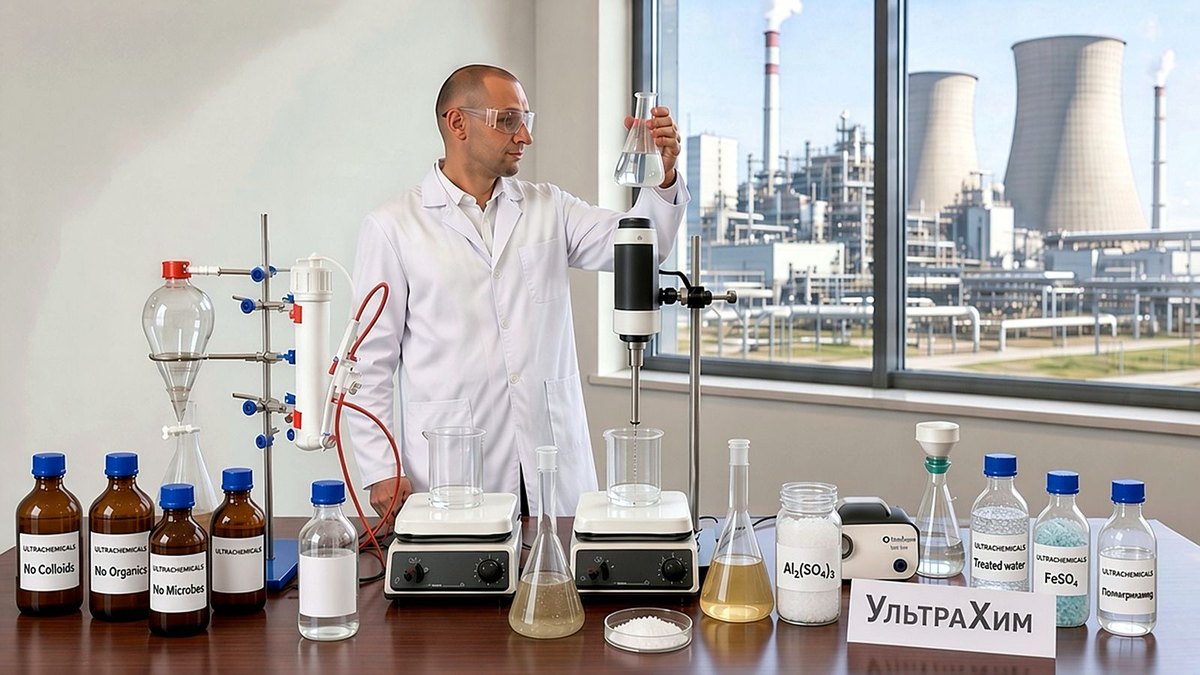
Problems we solve
- High hardness and mineralisation of groundwater: calcium, magnesium, sulphates, sodium chlorides.
- Risk of scaling on membranes and equipment: calcium carbonate, gypsum, iron, manganese and silicon compounds.
- A ban on or restriction of the discharge of liquid effluent and regeneration solutions.
- Several consumers with different water quality requirements.
What we do
- Chemical and physicochemical water analysis, ion balance check, calculation of salt composition, assessment of scaling risk and source suitability.
- Process selection: chemical softening, iron and manganese removal, mechanical clarification, Na-cation exchange, reverse osmosis, schemes with antiscalants and acidification, concentrate treatment including desulphation.
- Techno-economic comparison of options: consumption of reagents and electricity, cost of 1 m³ of water.
- Calculation of the water and salt balance, splitting the water into streams of different quality for different consumers.
- Laboratory work-up of process stages, PFD, design input data and recommendations.
Our technology for highly mineralised waters
For hard chloride-sulphate waters we recommend a combined scheme in which the salts do not go to effluent but are removed from the process as solid mineral products.
- 1
Chemical softening
precipitation of CaCO₃ and Mg(OH)₂, together with Fe, Mn and part of the Si.
- 2
Mechanical filtration
removal of residual suspended solids.
- 3
Barrier Na-cation exchange
polishing to remove residual hardness.
- 4
Reverse osmosis, 3 stages
process water for consumers.
- 5
Desulphation of the CaCl₂ concentrate
gypsum is removed, the NaCl solution is returned to the cycle.
Flow diagram: raw water → 1 → 2 → 3 → 4 → permeate to consumers; concentrate → 5 → gypsum and sodium chloride solution to the process cycle.
Why not “standard” schemes
| Option | Principle | Limitations for hard, highly mineralised waters |
|---|---|---|
| Antiscalants and acidification upstream of RO | Minimum equipment and capital expenditure | Ca, Mg and sulphates remain in the water; acidification does not protect against gypsum and silicates; an expensive broad-spectrum antiscalant is needed; the concentrate is difficult to dispose of |
| Ion-exchange softening upstream of RO | Widely used, well-proven scheme | High salt consumption for regeneration at high hardness; Ca and Mg go into regeneration effluent rather than into a solid product |
| Our scheme: chemical softening + Na-cation exchange + RO + desulphation | Salts are removed as precipitate; the concentrate is returned to the cycle | Simultaneously delivers the required water quality, zero liquid discharge and a closed water and salt cycle |
Benefits for the client
- No antiscalants, acid or coagulant: fewer expensive reagents, simpler operation.
- No liquid discharge: the sodium chloride concentrate is returned to the process cycle.
- Secondary mineral products: calcium carbonate, magnesium hydroxide and gypsum are removed as solids rather than with the effluent.
- Low load on ion exchange: most of the hardness is removed chemically, so salt consumption for regeneration is minimal.
- Water for each consumer: streams of different quality without excessive treatment of the entire volume.
Work stages
Stage 1
Receipt of the sample, review of the client’s materials, problem definition according to the terms of reference.
Stage 2
Refining the water composition: full analysis with an ion balance check using certified methods and verified measuring instruments.
Stage 3
Comparison of options, including techno-economic comparison; laboratory testing of process stages; selection of reagents.
Stage 4
Water and salt balance, PFD, design input data and recommendations.
Stage 5
By agreement: pilot tests on site, support during design and commissioning together with our partners.
Result
- A reliable characterisation of the source and a well-founded choice of technology.
- Laboratory confirmation of the process stages and the water and salt balance of all streams.
- Process flow diagram, specific consumption of reagents and electricity, recommendations for design and for the process operating procedure.
Case study
Potash industry, 2026. We carried out research on the preparation of process water for the processing plant of a potash producer. The raw water is highly mineralised sodium chloride-sulphate groundwater of increased hardness; the terms of reference required zero liquid discharge. Three pre-treatment options upstream of reverse osmosis were compared; the combined scheme described above was adopted and tested in the laboratory. It delivers process water of the required quality, splits it into streams for different consumers, returns the sodium chloride concentrate to the cycle and removes calcium carbonate, magnesium hydroxide and alpha-gypsum as secondary products.
How to get started
Send your terms of reference, water analysis report or a water sample to info@paradpro.ru and we will prepare a research programme and a commercial proposal for the research work.
Send request
Describe the facility and the water treatment task, and send a water analysis report or terms of reference. We will prepare a research programme and a commercial proposal.